
Structural Drying & Moisture Control in Bellaire, TX
A floor that feels dry isn’t always dry.
After a leak or flood, the surfaces dry quickly. The carpet stops feeling damp and the drywall looks normal again. But the water that soaked into wall cavities, under hardwood, into the concrete slab, or into the crawlspace can stay there for weeks. In Bellaire’s humid climate, that trapped moisture is what leads to mold, cupped floors, musty odors, and new flooring that fails a few months after it’s installed.
Our drying work has one goal: get your home back to a measured dry standard, and show you the readings that prove it.
-
Based on Bellaire Blvd
-
IICRC-certified technicians
-
Licensed & insured
Four Tools For Four Steps Of Structural Drying Process
Professional water damage drying isn’t just putting fans in a room. Each piece of equipment does a specific job, and it only works if it’s placed and monitored correctly.
1. Moisture Mapping: Finding Where the Water Went
What it is: We take readings across floors, walls, ceilings, cabinets and trim with pin and pinless moisture meters, and mark the edges of the wet area on a moisture map.
Why it matters here: Water spreads farther than it looks. It moves under flooring, wicks up drywall, and travels along the slab. A room that looks like it has a 3-foot wet spot may have wet materials 10 feet away, behind a cabinet or under a hallway floor.
What you’ll see: A technician checking walls and floors in a grid, with markings or a written map showing exactly what’s wet and what isn’t. We repeat the readings every day.
2. Thermal Imaging: Seeing Behind Walls Without Opening Them
What it is: Infrared cameras show temperature differences on surfaces. Wet materials usually appear cooler because evaporation lowers their temperature.
Why it matters here: A thermal camera helps us find hidden moisture inside walls, above ceilings, and under floors without cutting anything open. It’s especially useful for tracking a slow leak back to its source.
An honest note: Thermal cameras show temperature, not moisture. A cool spot could also be an air vent or missing insulation. We always confirm with a moisture meter before calling something wet.
3. Commercial Dehumidifiers: Taking Water Out of the Air
What it is: low-grain refrigerant (LGR) dehumidifiers, and desiccant dehumidifiers for dense materials. These pull large amounts of water out of the air every day.
Why it matters here: Houston-area air is already humid for most of the year. Without dehumidification, the moisture that evaporates from your floors and walls just stays in the room and soaks back into your drywall, furniture and cabinets. A home dehumidifier or your AC can’t keep up with a water damage job.
4. Air Movers: Speeding Up Evaporation
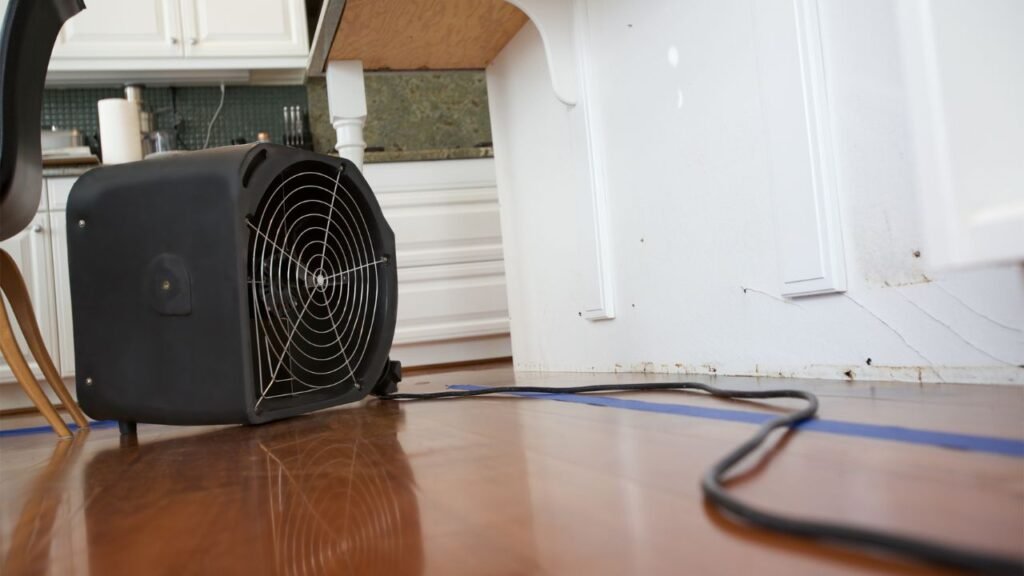
What it is: High-velocity fans aimed along walls and floors to move air across wet surfaces.
Why it matters here: Air movers speed up evaporation. Dehumidifiers remove the moisture that evaporation puts in the air. You need both working together. Too many air movers without enough dehumidification makes a room more humid, not drier.
Placement matters: We angle air movers along walls and space them around the room so the air circulates. The number depends on the room’s size and how wet it is, not a standard count.
Drying Inside Wall Cavities
When water gets inside a wall, the wall cavity can stay wet long after the room looks dry.
For clean water (a burst pipe or supply line), we can often save the drywall. We drill small holes near the bottom of the wall, usually behind the baseboard where they’ll be hidden, and push dry air into the cavity with a specialized wall-drying system. This dries the inside of the wall without tearing it out.
For floodwater or sewage, the drywall comes out. Contaminated water can’t be dried in place. See our [flood and storm damage restoration page] for how flood cuts work.
We also check:
- Insulation. Wet insulation holds water against the studs and usually has to be removed.
- The bottom plate. The board the wall sits on is often the last part of the wall to dry.
- Cabinets on exterior and plumbing walls. We may remove toe-kicks and drill small holes behind them to get air underneath.
Drying Concrete Slabs and Water Under Floors
Most Bellaire homes sit on a concrete slab. Concrete absorbs water and releases it slowly, much more slowly than drywall or wood.
Why slab drying matters:
- Hardwood, laminate or vinyl installed over a slab that’s still wet can cup, buckle, lift or grow mold underneath.
- Flooring manufacturers set moisture limits for slabs, and a warranty may not apply if the slab isn’t tested first.
What we do:
- Remove flooring that traps water against the slab, if it can’t be saved
- Take moisture readings on and in the slab
- Use dehumidifiers and air movers aimed at the slab surface, and desiccant drying where needed
- Keep checking until the slab is within the limits for new flooring
Slab leaks: Houston’s expansive clay soil swells when wet and shrinks when dry, which puts stress on plumbing lines under the slab. A leak under the slab can show up as warm spots on the floor, a rising water bill, or damp flooring with no obvious source. Moisture mapping and thermal imaging help us find where water is coming up.
Hardwood Floor Drying
Many Bellaire homes have solid oak or other hardwood floors. They’re worth trying to save.
If we get to wet hardwood early and the water was clean, we can often dry it in place with floor drying mats that pull moisture up and out of the boards and the subfloor. Some cupping flattens out as the wood dries. We wait until the boards are fully dry before anyone decides whether to sand, refinish or replace.
The worst thing you can do is sand cupped hardwood while it’s still wet. When it dries, the boards can crown, which is permanent.
Crawlspace Drying for Pier-and-Beam Homes
Some of Bellaire’s older homes are built on pier-and-beam foundations, with a crawlspace between the ground and the floor. These homes need a different drying plan.
What goes wrong in a crawlspace after water damage:
- Water pools on the clay soil underneath and stays there. Clay drains slowly.
- Humid air under the house keeps the floor joists, subfloor and sill plates damp.
- Damp wood under the house is where mold and wood rot usually start, and they can go unnoticed for months.
- Moisture from below can make hardwood floors above cup, even if water never got into the house.
How we dry a crawlspace:
- Pump out standing water under the house
- Remove soaked insulation from between the floor joists
- Set up dehumidifiers and air movers in the crawlspace
- Take moisture readings on joists, beams and subfloor
- Check the vapor barrier (the plastic sheeting on the ground) and replace it if torn or missing
Longer-term fixes to ask about: a new or sealed vapor barrier, better drainage away from the foundation, and a crawlspace dehumidifier for homes that stay damp year-round.
Your Home Type Decides the Structural Drying Plan
| Home type | Where moisture hides | What we focus on |
|---|---|---|
| Older slab-on-grade ranch | Under hardwood, bottom of walls, the slab | Floor drying, wall cavity drying, slab readings |
| Older pier-and-beam | Crawlspace, joists, subfloor | Crawlspace water removal and dehumidification |
| Newer elevated home | Garage, ground-level rooms, mechanical areas | Lower-level walls, garage drywall, equipment areas |
| Two-story home with an upstairs leak | Ceiling below, floor joists, insulation | Ceiling and joist drying, attic-to-ceiling moisture tracking |
Myths About Structural Drying a Wet House
“Opening the windows will help it dry faster.”
Not in Bellaire for most of the year. Outdoor air is often more humid than the air inside, so opening windows adds moisture. Keep windows closed while the dehumidifiers are running.
“Turning the AC way down will dry things out.”
Air conditioning removes some humidity, but it isn’t designed for this job. A very cold house can also slow evaporation. We’ll recommend a thermostat setting.
“If it looks dry after a couple of days, it’s done.”
Surfaces dry first. Studs, subfloors and slabs dry last. Only moisture readings tell you when the job is done.
“Box fans from the garage are good enough.”
Household fans move some air, but without dehumidification, they mostly move wet air around the house.
“Drying is just the start of rebuilding.”
It’s the most important step. If walls are closed up or floors installed over wet materials, the damage often has to be torn out and done again.
What “Dry” Actually Means
We don’t declare a home dry based on how it looks or feels, or on a set number of days. We use a drying goal.
Before drying starts, we measure unaffected materials in your home, such as drywall, wood and slab in a room that didn’t get wet. Those readings become the target. Wet materials are considered dry when they reach that same level. This is the industry standard approach for water damage restoration.
You get:
- A daily moisture log for each affected room
- Photos of equipment placement
- Final readings showing each material reached its drying goal
This record matters for your insurance claim. Insurers generally want to see why drying equipment was needed each day. It also matters for your contractor, who needs to know it’s safe to close up walls and install new flooring.
Living With Structural Drying Equipment
Most structural drying jobs take about 3 to 5 days. Dense materials like hardwood, slabs and crawlspace framing can take longer.
What to expect:
- Noise. Air movers and dehumidifiers are loud and run 24 hours a day. Many families move out of the affected rooms or stay elsewhere.
- Warmth. Equipment raises room temperature somewhat, which helps drying.
- Power. Equipment uses several circuits. [Mention if you bring generators or manage circuit loads.]
- Daily visits. We come back each day to take readings and move or remove equipment as areas dry.
Please don’t:
- Turn equipment off at night, even if it’s noisy. Drying stops when it’s off.
- Move air movers or unplug dehumidifiers. Placement is planned.
- Open windows or doors to the outside.
Signs a Past Leak or Flood Wasn’t Fully Dried
If your home had water damage before, whether you handled it yourself or another company did, watch for:
- A musty smell that comes back on humid days
- Hardwood that’s cupping or has gaps between boards
- Baseboards or paint bubbling near the floor
- Soft spots in the floor
- Mold spots at the bottom of walls or inside base cabinets
- Allergy-like symptoms that improve when you leave the house
If you notice any of these, we can do a moisture inspection with thermal imaging to see whether moisture is still present and where it is.
Not sure if your home is really dry?
We’ll measure it and show you the readings.
Call (713) 224-7579, any time.